
 true77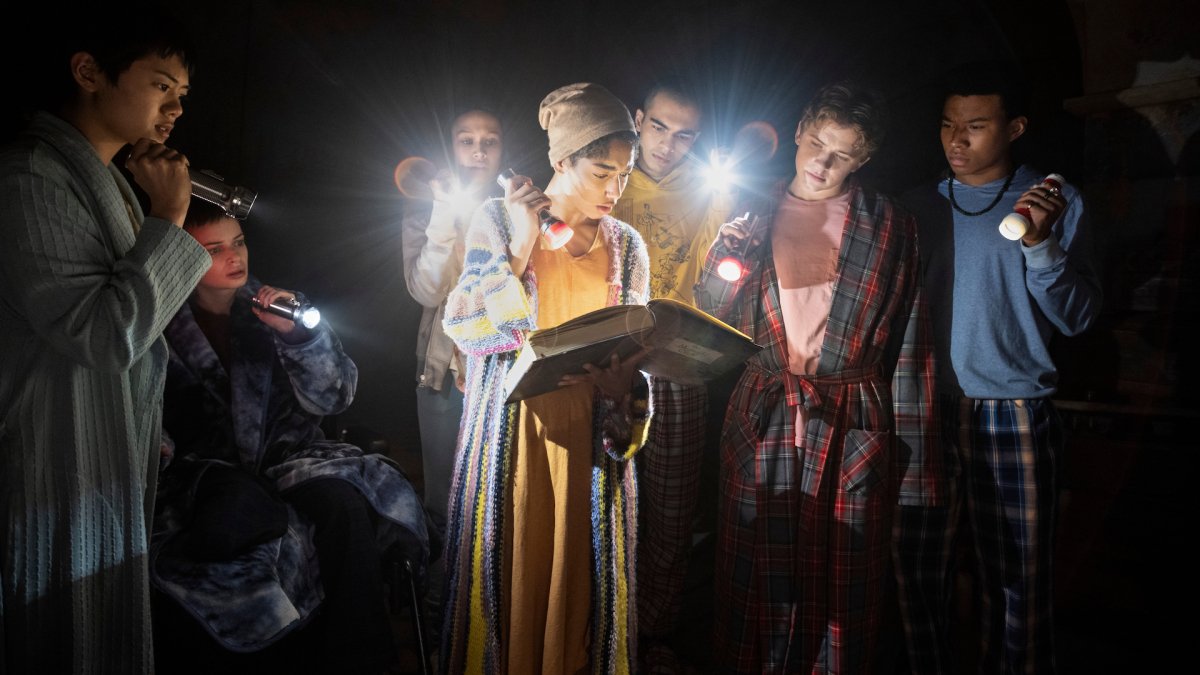
“To those before and those after. To us now and to those beyond. Seen or unseen. Here but not here.” Having a frank conversation about mortality and the time we have left doesn’t seem like obvious fodder for a Netflix horror series, but Mike Flanagan has long perfected reeling you into the deepest philosophical dialogue while scaring the crap out of you. And The Midnight Club is no exception.
Continuing the frightening but poignant examinations of death, spirituality, and trauma we’ve relished in The Haunting of Hill House, The Haunting of Bly Manor, and Midnight Mass, Flanagan and Leah Fong examine the impermanence of life from a new perspective in their deeply moving adaptation of Christopher Pike’s The Midnight Club. Flanagan has well established his penchant for wandering extremely haunted halls while exploring what happens after we die through his previous series. Yet, even while it brims with the writer-director’s almost gleeful reliance on jump scares and slowly unveiling a complex mystery, with The Midnight Club, these deeper conversations are conveyed through a group of young people with terminal illnesses.
The series is focused on eight young adults — Ilonka (Iman Benson), Spencer (Chris Sumpter), Natsuki (Aya Furukawa), Amesh (Sauriyan Sapkota), Anya (Ruth Codd), Cheri (Adia), Sandra (Midnight Mass‘ Annarah Cymone), and Kevin (Midnight Mass‘ Igby Rigney) — living at the magnificent 20th-century Gothic palliative care facility, Brightcliffe Hospice: “A place for teenagers to transition on their terms.” In this highly lovely place with a dark history, The Midnight Club immediately presents you with the imminent possibility of death for people who have yet to reach their 20s.
“Brightcliffe isn’t about battles, it’s about permission to leave the battlefield,” Brightcliffe’s Dr. Georgina Stanton (A Nightmare on Elm Street legend Heather Langenkamp) tells Ilonka on arrival. “To focus on living instead of fighting. We aren’t about a fight, and it certainly isn’t losing a battle. Every living day here is a win.”
In the series, the club pays tribute to those who have come before them with a toast that takes on more meaning as the series progresses: “To those before and those after. To us now and to those beyond. Seen or unseen. Here but not here.” Whatever darkness they deal with on their own, the safety of the late-night library is paramount, somewhere the group can always find solace, and the truths they offer up go much deeper than what’s discussed at the facility-run group therapy.
“The Midnight Club”‘s talented cast deliver and star in their nightly stories (all based on individual Pike books) with sublime light and shade, pacing the scares and jokes as well as your best pal at a sleepover holding a flashlight under their face. Kevin debunks ideas of “perfection” by weaving a David Fincher-style tale of a teen serial killer fueled by sinister voices (“The Wicked Heart”). Sandra makes apologies to a friend through a ’40s detective noir (“Gimme A Kiss”). In one of the most powerful episodes, Natsuki shares her experience of depression and attempted suicide through an urban legend-style hitchhiker horror tale (“The Road to Nowhere”). (A warning to viewers: There are several depictions of self-harm and suicide in the show.)
Spencer and Amesh both weave time-traveling sci-fi tales (“The Eternal Enemy” and “See You Later”), in fun yet poignant nods to the power of time, how much we have left, how we’d spend it, and how far one may go to secure more of it.
“It ain’t easy, you know, scaring someone who’s already been given the worst news they’ll ever get,” says Anya. “We’re a tough audience.”
Anya, the longest-residing Brightcliffe resident, a complicated nihilist who’s overprotective of the group, tells the violent tale of “The Two Danas” taken from Pike’s book “The Midnight Club”. A standout performance in Cobb’s talented hands, Anya delivers the best of the Midnight Club’s gallows humor with a level of deadpan glee that both heightens and eases the tension, clearing the air of any nonsense. The group’s gravitation toward this brand of dark humor empowers them to feel ownership of their circumstances, speak frankly about their various states of declining health, and create a kind of shorthand between themselves.
But this is a Mike Flanagan show, so you know there’s haunting afoot. Terror begins to take hold of the Midnight Club, as “living shadows” begin to haunt certain residents of Brightcliffe. Natsuki’s Japanese horror movie-style story in episode 1 drops a total of 17 jump scares, a feat called out by Spencer. “Don’t be lazy,” he says to Natsuki. “Anyone can bang pots and pans behind someone’s head. That’s not scary, it’s just startling. And it’s lazy.” Who these figures are and what they represent becomes clearer as the episodes progress, and the power of facing them becomes what Wes Craven would have called facing the enemy, “for the enemy is fear.”
Fong and Flanagan use this fear to explore the lengths people may go to beyond conventional medical treatment to really make sure every possibility has been checked off, every divine being on the side, every naturopathic avenue tested for additional healing. It’s through this quest Ilonka meets likable neighbor Shasta (“Midnight Mass”‘s unshakable Samantha Sloyan) who fosters her enthusiasm for alternative therapies when Ilonka’s not being well and truly haunted. The further Ilonka investigates all this, the deeper into Brightcliffe’s history and ritual territory she goes. Ritual comes in many forms for the Midnight Club, from the innocent fun of storytelling sessions to empowered Death Day celebrations, poignant, heartbreaking farewells, and yes, darker dabbling with ancient traditions.
Amid the “living shadows” that haunt the Midnight Club, however, Flanagan and Fong allow them moments of love, friendship, and teenhood — they have crushes, address family tension and trauma, say stupid things when they’re high, and mess up. But there’s a more intense level of friendship here, as the group tell each other their darkest secrets, biggest regrets, and happiest memories — all the things they haven’t been able to say or share to their families or friends. And at times they even edit each other’s stories, for better or worse.
The Midnight Club: A Deeply Moving Horror Series
Unafraid to talk about death, life, friendship, trauma, and love, The Midnight Club is a deeply moving horror series whose unique characters and their stories (the real ones and made-up fireside ones) will stay with you long afterward. Using horror to confront the idea of dying through this particular group of young people eliminates all the bullshit and cuts straight to what matters in the end. But it’s also a highly enjoyable ride through horror fiction and a compelling mystery.
Streaming on Netflix
The Midnight Club is now streaming on Netflix.