
 true77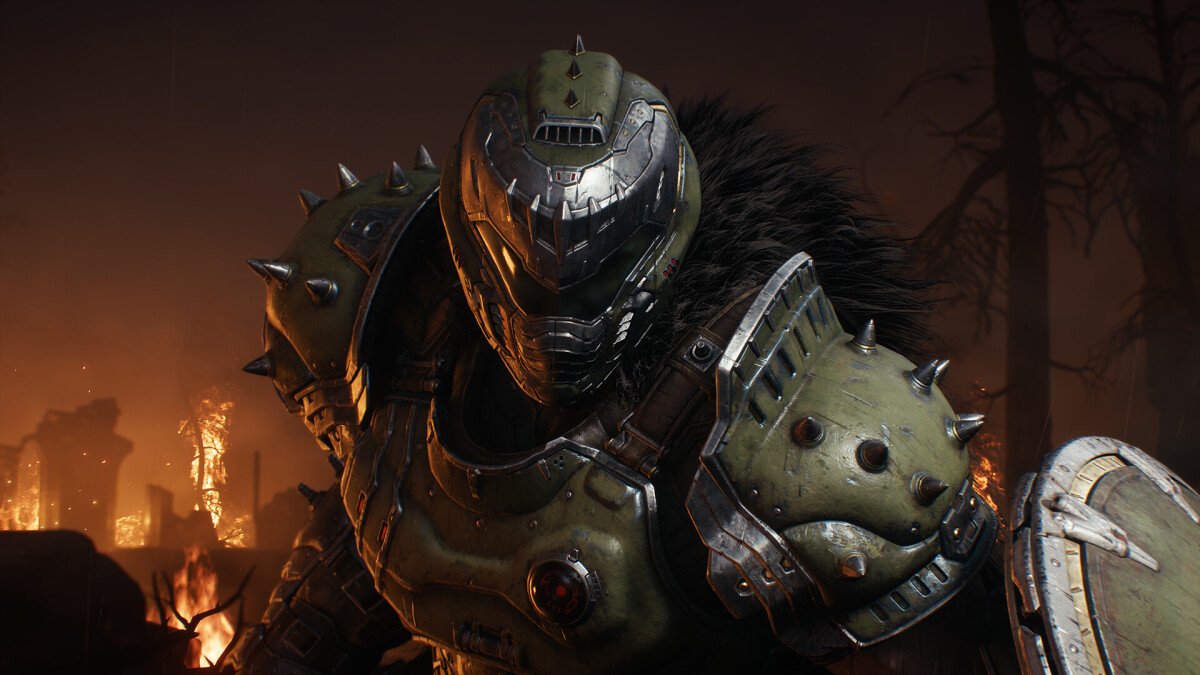
The release of the original Doom in 1993 was a pivotal moment in video game history. Widely considered one of the most influential first-person shooters (FPS), Doom‘s relatively sparse plot followed an unnamed marine (dubbed “Doom Guy” by fans) fighting demons on Mars. Several decades have passed since then, and expectations for games have significantly evolved. Even so, there are some classic truths that have stood the test of time. One of these is that the joy of mindlessly plowing through demons and exploding them like bloody piñatas remains eternal.
Taking on Hell with guns and hubris
Developed by id Software and published by Bethesda, Doom: The Dark Ages hearkens back to the original ’90s game in many ways, complete with floating green armor packs, blue health pickups, and even the Doom Guy’s face in the bottom center of the screen offering an indication of your health. Unsurprisingly, this also includes the game’s focus on FPS gunplay. Doom: The Dark Ages offers a selection of different weapons which vary gameplay and encourage you to switch up your playstyle.
Fortunately for those who prefer their mindless violence even more mindless, I also found the “just keep firing until it stops moving or you run out of ammo” strategy was also entirely valid. Personally, I largely favored charging in with my shield like a rhino, locking on to my paper bag enemies and rocketing across the battlefield to bash them into satisfying gory explosions. Zipping between demons like a deadly ping-pong ball also had the added benefit of bringing me close enough to administer a Super Shotgun to their sturdier colleagues’ faces, or a Gauntlet to the gut.
Aside from the plot and gunplay, Doom: The Dark Ages also expands beyond the franchise’s typically linear gameplay to include some maps that are more open. Even so, the open segments I explored in my preview session weren’t anywhere near as expansive as the phrase “open-world” might have one imagine. Rather, they merely offered a little room to choose the order in which you tackle battles, or explore to discover resources in secret areas. According to the cutscenes, the Slayer’s captors have erased everything from his mind except “hatred for demons.” Even so, he apparently still retains a working knowledge of commerce, being capable of collecting gold to exchange for weapon upgrades.
Fortunately, you don’t have to spend your hard-found gold on ammo, shields, or health. Aside from the aforementioned pickups found around the map, enemies will also drop health upon death if you’re wounded. Murdering demons with up close melee attacks can yield ammo as well, encouraging players to keep fighting even against dire odds.
Running, gunning, and punching demons in the face isn’t the only chaos you can unleash in Doom: The Dark Ages. Some chapters also allow you to punch giant demons in their giant faces with a giant humanoid Atlan mecha, or engage in aerial combat atop a Mecha Dragon.
The Mecha Dragon is relatively agile, locking on to stationary enemies and swivelling around that point to dodge incoming fire. In contrast to both this and Doom: The Dark Ages‘ non-mech assisted gunplay, combat in the Atlan takes a more sluggish pace, requiring you to lumber up to your opponent before taking a swing like kaiju duking it out in the streets of Tokyo.
It’s an interesting change of pace, and made me feel less like a rhino with a gun and more like a giant toddler inadvertently ruining everything. And just like a toddler, I also felt absolutely no guilt about any of it.
Doom: The Dark Ages generally doesn’t include friendly fire (a fact I discovered after immediately attempting to mow down the first cowering soldiers I encountered). However, the Atlan mecha does allow you to decimate your allies by knocking down bridges they’re standing on and stepping on their tanks. The unfriendly destruction is so complete in fact that one could reasonably argue that deploying the Atlan does more harm to the war effort than good.
For my part, turning my allies into pancakes was largely not deliberate — at least, not at first. Sometimes there’s just a bridge in the way of your journey, and unfortunately the mecha’s designers didn’t feel that the ability to step over objects was a necessary function to include.
However, this is also where I found Doom: The Dark Ages‘ plot a little bit more important to my gameplay experience. I’d have felt a lot worse about killing my allies if they weren’t keeping me as a mind-controlled murder slave. Once I remembered this factoid, I had no qualms stomping them like grapes.
Doom: The Dark Ages blends old and new
Doom: The Dark Ages didn’t always keep up the frantic pace I’d expected. Even aside from cutscenes and mecha sections, there were only a few moments during my preview where I got that locked-in focus and flow synonymous with mowing down a seemingly neverending horde of demons. I also remain largely unconvinced that Doom: The Dark Ages‘ cutscenes and focus on plot are entirely necessary, particularly as the franchise’s primary appeal has not historically revolved around its story. It will be interesting to see how this impacts the pace of the game in its final release.
Even so, I found demolishing demons in Doom: The Dark Ages nostalgic, refreshing, and fun, hearkening back to simpler times while still working to add features befitting modern video game standards (including robust accessibility settings). As everything in the world seems to grow increasingly complex, the simple joys can feel increasingly hard to find.
Doom: The Dark Ages is a simple joy, offering a cathartic, mindless escape from complicated problems that can’t be solved by indiscriminate violence. There are no moral debates here, no difficult questions or philosophical dilemmas to keep you up at night. There is only evil, and there is gun.
This I can appreciate. Sometimes you just need to work out your anger via a simple demon-busting power fantasy. In that, Doom: The Dark Ages may have you covered.
Doom: The Dark Ages arrives May 15 on PlayStation 5, Xbox Series X/S, and PC.