
 true77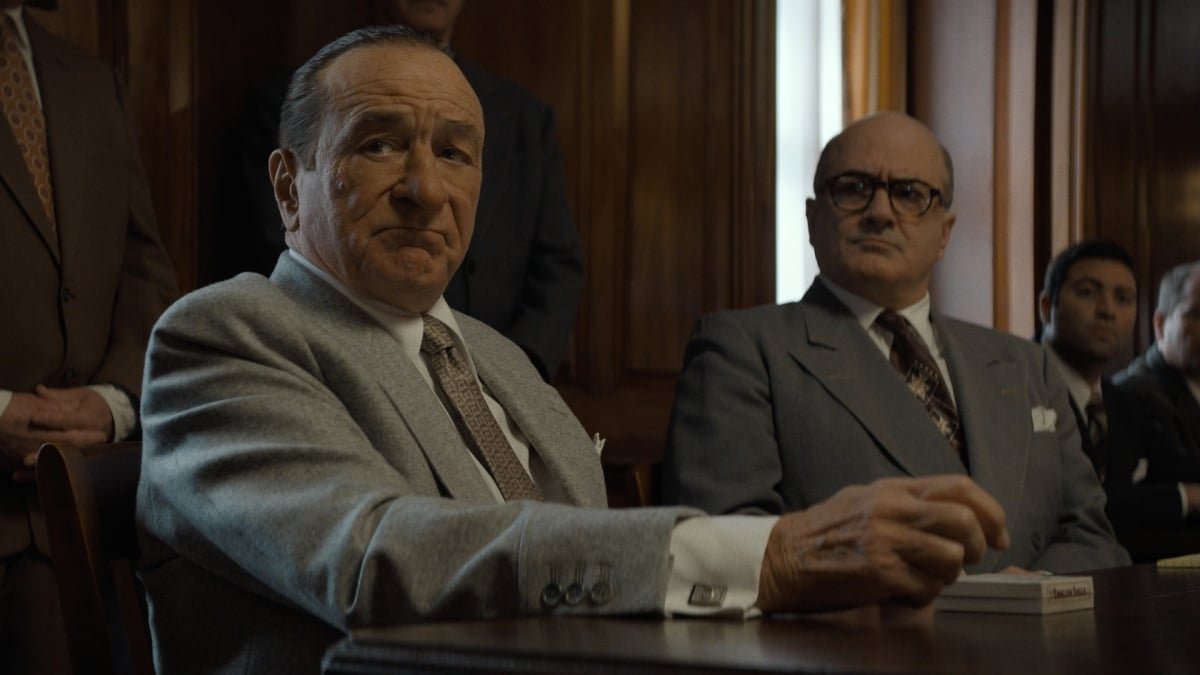
The promise of Robert De Niro playing not one but two infamous gangsters might be enough to tempt fans of Goodfellas or the Godfather trilogy into seeing The Alto Knights. But be warned. While the promise of double De Niro is tempting, the movie itself is inexplicable.
On paper, The Alto Knights sounds terrific. The real-life story of Vito Genovese and Frank Costello, two childhood friends turned rival Mob bosses, is peppered with the classic elements of gangster movies, including macho face-offs, sharp-tongued wives, vicious betrayals, a criminal conspiracy, and merciless, violent murder. Who better to draft such an adapted screenplay than Nicholas Pileggi, the author and co-screenwriter behind Martin Scorsese’s Goodfellas and Casino? And who better to headline than recurring Scorsese collaborator/iconic tough guy Robert De Niro?
However, director Barry Levinson makes some absolutely befuddling choices in The Alto Knights. The potential promised by its talent is squandered in a completely confounding gangster flick.
Why is Robert De Niro playing two characters in The Alto Knights?
From the start, Vito Genovese and Frank Costello are depicted as very different kinds of gangsters, though they share a similar origin. These Italian immigrants became friends as young men, hanging around the Alto Knights Social Club in 1910s New York City. Associates of the notorious Lucky Luciano, both made their way in the city through criminal enterprises. However, by the 1930s, it was Genovese who was chosen to run the Family — that is, until a double homicide investigation chased him back to Italy. Before he left, Genovese handed the reins to his trusted friend, Costello, expecting to resume control upon his return.
However, in the intervening decades, Costello’s leadership of the Mob was so successful that on top of him becoming obscenely rich, he’d made enough political connections to achieve a sheen of respectability. In The Alto Knights, Frank is a suave philanthropist who attends glamorous charity balls with his wife, Bobbie (Debra Messing), a chic Jewish socialite, on his arm. Meanwhile, Vito is a more Scorsese kind of gangster — close to the streets, gnawing on a cigar, spitting out threats and curse words with equal ease. His wife is a sultry Italian divorcée (Kathrine Narducci) who runs her nightclub with passion and a big mouth.
Frank is the kind of smooth criminal De Niro has played before, like in Scorsese’s Killers of the Flower Moon, where his affluence and polite veneer hide an ocean of sins. Vito is more mercurial, the kind of primed-for-eruption character De Niro played in Taxi Driver or Goodfellas. So there’s a curious experiment in having the octogenarian actor attempt to straddle this range of representation that he’s managed across decades, all in one film.
Masterfully applied prosthetics distinguish Frank from Vito, as do the voices De Niro uses for them. Frank is more traditionally De Niro, with a low, husky, alert but world-weary delivery. Vito is higher pitched and sharper in cadence; frankly, it feels like a Joe Pesci impersonation. But there are enough shared physicalities in both stride and facial expressions — especially in a couple of scenes where the characters face off — that this double-casting feels like a stunt that doesn’t pay off. It’s just obvious it’s the same guy, but why is less clear.
Perhaps Levinson couldn’t decide which role his Wag the Dog collaborator would be best in and so went for both. Maybe he thought this dual-casting would build a message about these mafiosos, something along the lines of how far they grew apart from their common past — sort of a “there but for the grace of God go I” kind of a thing. However, if that were the case, you’d think Levinson would do the same for the flashbacks, casting the same actor to play both Young Frank and Young Vito. Instead, Luke Stanton Eddy and Antonio Cipriano play these roles, respectively, but even calling them roles feels like a stretch considering their screen time. Astonishingly, The Alto Knights engages less with flashbacks than it does with black-and-white staged photographs intercut with archival B-roll and an egregious voiceover that barrels over everything.
The Alto Knights feels like a gangster movie with zero patience for its own story.
It is a truth universally accepted that gangster movies are allowed to be long. Goodfellas is two hours and 26 minutes. Casino is two hours and 58 minutes. The Godfather Part II is three hours and 22 minutes. Sure, some might grouse, but overall it’s understood: That time is required not only to properly unravel the secretive lives and complicated criminal conspiracies of its anti-heroes, but also to allow audiences to experience the intoxicating confidence of being a mobster. For instance, the Goodfellas’ long take winding through the Copacabana on Henry and Karen’s first date allows us to walk in the gait of a gangster, experiencing the access, the power, and the thrill. Filmmakers need pace and time to build the intoxicating atmosphere that makes murder feel like an understandable trade-off.
Reckless Storytelling in “The Alto Knights”
Unlike its predecessors, The Alto Knights rushes through its plot with a chaotic and disorganized structure that only serves to alienate its audience. The movie kicks off abruptly with the 1957 assassination attempt on Frank Costello, followed by a perplexing voiceover from Frank himself. As the story unfolds, director Levinson fails to engage viewers, resorting to uninspired flashbacks and tedious montages to establish character connections.
Lost in Translation: The Downfall of “The Alto Knights”
While voiceover can enhance a gangster film, in this case, it falls short of expectations. De Niro’s narration attempts to salvage a disjointed narrative, but ultimately fails to give coherence to the jumbled events and violence depicted on screen. The excessive use of voiceover in The Alto Knights glosses over crucial moments, leaving viewers disconnected and disengaged.
Unfortunately, Levinson’s fixation on cross-cutting sequences further compounds the film’s issues, detracting from its potential for tension and emotional impact. The rushed pace and lack of breathing room result in missed opportunities for meaningful storytelling, culminating in a gangster flick that fails to deliver on its promises.